
Multiplying Fractions With Whole Numbers Made Easy

Understanding the Basics of Multiplying Fractions
Multiplying fractions with whole numbers is a fundamental concept in mathematics that can seem intimidating at first, but with practice and patience, it can become second nature. To start, it's essential to understand the basics of fractions and how they work. A fraction is a way of representing a part of a whole, and it consists of a numerator (the top number) and a denominator (the bottom number). When multiplying fractions with whole numbers, the process is relatively straightforward.
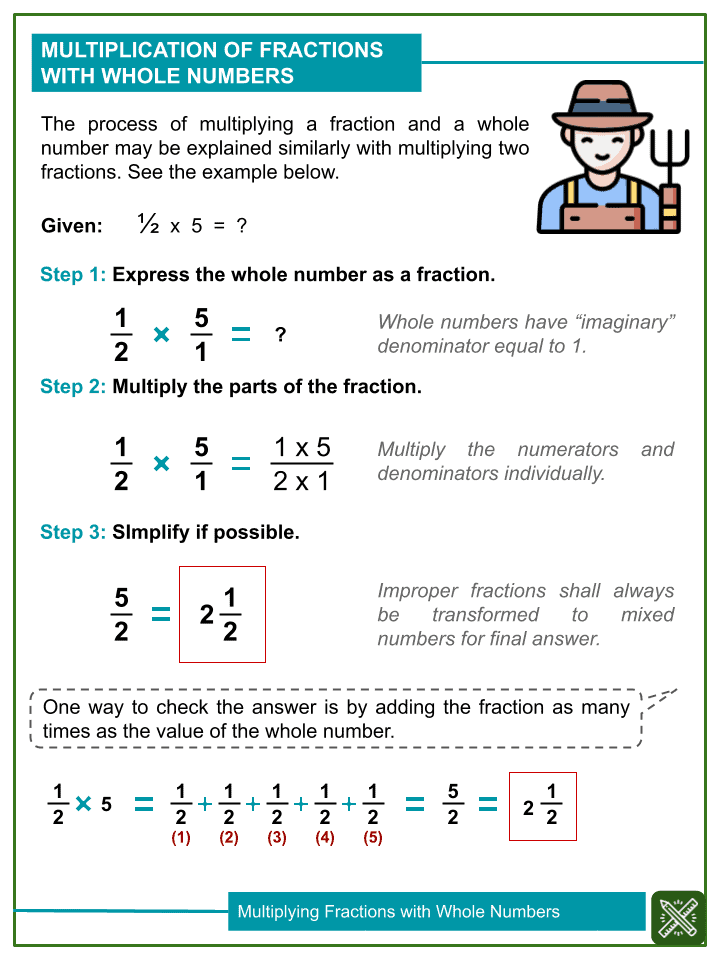
To multiply a fraction by a whole number, you simply multiply the numerator of the fraction by the whole number, and then keep the denominator the same. For example, if you want to multiply the fraction 1/2 by the whole number 3, you would multiply 1 (the numerator) by 3, which gives you 3, and then keep the denominator (2) the same, resulting in 3/2.
Practical Examples of Multiplying Fractions With Whole Numbers
When multiplying fractions with whole numbers, it's crucial to remember that the whole number can be represented as a fraction with a denominator of 1. For instance, the whole number 4 can be written as 4/1. This makes it easier to multiply the fraction by the whole number, as you can simply multiply the numerators and denominators. For example, if you want to multiply the fraction 1/2 by the whole number 4, you would multiply 1 (the numerator) by 4 (the numerator), which gives you 4, and then multiply 2 (the denominator) by 1 (the denominator), which gives you 2, resulting in 4/2, which simplifies to 2.
Now that you understand the basics of multiplying fractions with whole numbers, let's look at some practical examples to help reinforce your knowledge. For example, if a recipe calls for 1/4 cup of sugar, but you want to make four times the amount, you would multiply 1/4 by 4, which gives you 1 (the numerator) multiplied by 4, resulting in 4, and then keep the denominator (4) the same, resulting in 4/4, which simplifies to 1. With practice and real-world applications, you'll become more confident in your ability to multiply fractions with whole numbers, making it easier to tackle more complex mathematical concepts.